
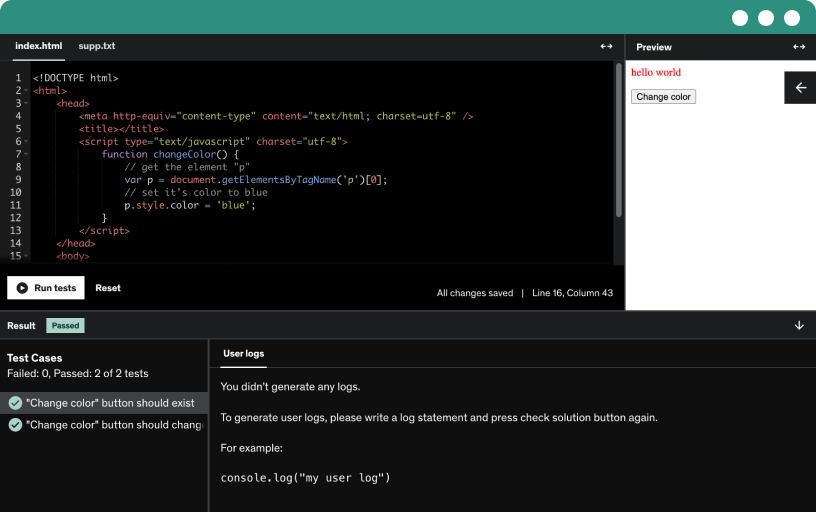
This course includes our updated coding exercises so you can practice your skills as you learn.
See a demo
Master Python foundations for data analysis through a hands-on, project-based course, from Jupyter notebooks to variables, operators, conditionals, loops, and functions, applying to MAVEN Ski Shop data from Excel.
Introduce the course project: analyze Black Friday sales with Python, process missing data, reshape and aggregate transactions, compute KPIs, build a data pipeline, and export to Excel.
Learn Python fundamentals for data analysis, including data types, variables, conditionals, loops, and functions for analytics use cases, using Jupyter Notebooks and Google Colab to prepare for analytics libraries.
Discover why Python is free, open source, powerful, and easy to learn, with broad use in data analytics, software development, machine learning, web scraping, game development, and an active community.
Explore why Python accelerates analytics with scalability, open source versatility, and automation that connects a database to Excel, empowering data prep, analysis, machine learning, and visualization using key libraries.
Explore the Python analytics ecosystem, starting from base Python fundamentals to powerful libraries like Pandas, visualization tools for charts, and machine learning libraries such as scikit-learn, statsmodels, and TensorFlow.
Learn how Python powers data roles—from analysts to data scientists and engineers—by automating workflows, manipulating data with pandas, and powering visualizations with Tableau and Power BI.
Install Anaconda and launch Jupyter notebooks, explore the notebook interface, and learn basic Python syntax, including comments, markdown, and the print function, with Google Colab notes.
Launch Jupyter Notebook from Anaconda Navigator, create a Python notebook titled Jupyter Practice in a Python course work folder, then save for easy access from the file system.
Explore the code cell as the coding environment, write in edit mode, run code with the play button or shift-enter, see input and output, and manage cells with shortcuts.
Learn how to use comments to explain code, choose useful inline and block comments, avoid clutter, and convert code cells to markdown to document workflows with headers, lists, and formatting.
Explore the print function in Python to display text and numbers, using quotes and commas for multiple values, and access function docstrings in the notebook.
Google Colab offers a cloud-based alternative to Jupiter notebooks, letting you run and store notebooks in Google Drive with internet access, and easily transfer files to and from Jupiter.
Discover practical Python help resources, from Google queries and Stack Overflow to official docs and analytics blogs, and learn to use Jupiter notebooks, markdown, and CoLab for workflows.
Explore Python data types, learn to identify and convert between them, and understand mutability and the type function across numeric, text, boolean, none, sequence, mapping, and set types.
Identify Python data types with the type function, and convert values using int, while diagnosing type errors through error messages to troubleshoot data workflows.
Explore intervals and mutability in Python. Discover how iterables like lists, dictionaries, sets, and strings can be traversed, modified, or kept immutable.
Learn how to name, assign, overwrite, and delete variables in Python, and keep track of values using intuitive names, proper spacing around the equals sign, and any data types.
Learn variable assignment by naming a variable like price, using the equals sign with spaces, printing values, computing price plus tax, and handling a price list and its type.
assign variables in python by setting price to five and tax to two, then compute total as price plus tax. print the total to verify the result.
Learn how to overwrite variables in Python by assigning new values, understand the underlying value versus the variable name, use placeholders for safe testing, and avoid memory waste.
Understand how the delete keyword removes variables from memory in Python and why printing a deleted name triggers an error. See when deletion helps free resources after merging datasets.
Learn how to overwrite and delete variables in Python by assigning new values, printing current values, storing backups in old variables, and using the delete keyword to remove names.
Define variable names by starting with a letter or underscore, using only letters, numbers, and underscores, avoid spaces and reserved keywords; follow snake_case like price_list_2019.
Discover how to track variables in a Python analysis notebook with %who and %whos, revealing names, data types, and contents for each variable, and their use in Jupyter and Colab.
Demonstrates naming and tracking variables in Python with who and whos, shows variable cleanup by deletion or restart, and advocates snake_case naming with valid examples.
rename variables to the format price_list_2018, price_list_2019, and price_list_2020, clean up unnecessary names, and review the price list notebook’s three price lists for 2018–2020.
Demonstrates proper variable naming in Python by assigning price lists for 2018, 2019, and 2020 using underscores and avoiding numbers, spaces, hyphens, and reserved keywords.
Master how variables function as memory-stored containers for values of any data type. Overwrite values, use placeholders or new variables, and follow Python naming rules with intuitive snake_case names.
Explore python's numeric data types, convert between them, and perform arithmetic operations and numeric functions to review data type handling and calculations.
Explore Python's numeric data types, including integers (whole numbers), floats, and complex numbers, with examples and notes on their use in data analytics and the rare role of complex numbers.
Explore Python arithmetic operators: addition, subtraction, multiplication, division, floor division, modulo, and exponentiation, and learn how parentheses and the order of operations produce correct results.
Explore numeric data creation, string-to-int and string-to-float conversions, and arithmetic in Python. Master order of operations, mixing integers and floats, and rounding and precision considerations.
Practice arithmetic operators through a financial calculations notebook to compute gross profit, gross margin, price for a 70% margin, sales tax, and one-year investment return on five snowboards.
Explore arithmetic operators in Python by calculating gross profit and gross margin, sales tax, and the amount after one year from reinvested profit, using parentheses to control order of operations.
Master Python numeric functions, including single-number round and abs, and multi-number sum, min, and max across iterables like lists, tuples, and sets.
Explore how to use Python's numeric functions to round numbers, compute absolute values, find minimum and maximum in lists, and sum scores with practical golf examples.
Apply Python numeric functions to find the lowest and highest prices from a seven-item list and compute the total cost of two of every item, rounded to the nearest dollar.
Learn to use Python numeric functions like min, max, sum, and round to compute costs from a price list, with optional variable assignments for two of every item.
Master numeric data types—integers and floats—while noting complex numbers are rarely used; apply Pandas order of operations with parentheses and built-in functions like round, abs, min, and max.
Explore strings, data type used to store text, creating from scratch or converting numbers, and manipulating with indexing, slicing, and string methods; use triple quotes for multi-line text and f-strings.
Learn string arithmetic in Python, combining strings with the plus operator, inserting spaces and symbols, converting numbers to strings for formatting, repeating strings with multiplication, and accessing words or characters.
Learn to create strings in Python with single, double, or triple quotes, use escape characters for apostrophes, write multi-line strings, perform string arithmetic and concatenation, and apply basic methods.
Learn to index strings with zero-based and negative indexing to access characters and data points in columns, handle the last character, and avoid index errors in Python for data analysis.
Learn string indexing with zero-based and negative indices to access first and end characters, counting apostrophes, and apply indexing to lists, tuples, and Pandas rows.
Index one letter from each of five text messages to spell Maven, using string indexing as shown in the attached notebook. Learn how this hidden message reveals a password.
Master string slicing by specifying start, stop, and step to extract parts of a string, including defaults and negative indices, and apply this to data analysis and pandas-style subsetting.
Explore string slicing in Python using a movie title to practice start and end indices, default steps, and negative steps. Learn to extract prefixes, suffixes, and reverse strings.
Master Python string slicing to extract testimonials and craft marketing copy, assigning phrases like 'I love skiing. It's my life.' and 'I love my life!' from a notebook.
Learn string slicing in Python to build a stream from a testimonial, using positive and negative indices, handling line breaks and quotes, and append punctuation.
Explore the length function to count characters in strings and elements in lists, and apply it to any iterable, enhancing indexing practice.
Compute the length of each message to index an alphabet and assemble a password. See how string addition and careful line breaks guide Python code toward spelling the word maven.
Explore essential string methods in Python, including find, upper, lower, strip, replace, split, and join, with examples and method chaining to clean and analyze text data.
Demonstrates how to use Python string methods like upper, lower, strip, lstrip, rstrip, replace, split, and join, and shows method chaining for text cleaning.
Combine messages into text, convert to lowercase, replace 'on the mountain' with 'at the ski shop', and count spaces to compute word count (spaces plus one) using Python string methods.
Explore essential Python string methods for data analysis and business intelligence, including join, strip, lower, replace, find, slicing, and count, plus a preview of f-strings.
Learn how to create dynamic text in Python by embedding variables in strings with f-strings and curly braces, as shown by examples using name and role.
Demonstrate f-strings by embedding a movie variable into text, printing dynamic updates as the variable changes, and using uppercase and repetition to display list outputs.
Use f-strings to format a string that takes product and price variables and prints each item's cost with a dollar sign, e.g., snowboard 9999 and scarf 1999.
Use f-strings to format the product price by prefixing with f and inserting the price variable, producing 'snowboard costs $99.99'. Adapt outputs automatically as variables change.
Strings store text and sequences of characters; use indexing and slicing to access them, apply string methods guided by Python documentation, and use f-strings to create dynamic strings.
Explore the boolean data type, boolean operators, and conditional logic to control program flow using true or false expressions.
Learn to use comparison operators and membership tests to produce boolean results and drive program flow, including equality, not equal, order comparisons, and the in and not in tests.
Learn how boolean operators combine multiple comparisons using and and or, explore short circuiting, and see how parentheses control the evaluation order in complex conditions.
Explore the boolean data type in Python, evaluating true and false, using not, equals, greater than, and membership tests using in and not in on strings and lists.
Use boolean operators to test inventory levels, price display, and a customer flag in a notebook, exploring zero, five, and conditions like greater than five and Chris with Super Snowboard.
Learn to use boolean operators to compare inventory against zero and five, display price when inventory is above five, and combine conditions with and/or logic.
Master Python control flow by using if statements and indentation to run code only when conditions are true, with examples like price > 100 and inventory checks.
Apply if, elif, and else statements to compare prices against expert, intermediate, and luxury thresholds, emphasizing proper order to avoid unintended matches and selecting a single, correct board.
Explore conditional flow in Python by stripping the leading C from a customer id, converting to int, and using if, elif, and else to award prizes by ranges.
Explore control flow by implementing inventory-based conditions that print out of stock for zero or less, low stock for one to five, and in stock for over five, with tests.
Develop and test a control flow that prints out of stock, low stock, or in stock messages based on inventory levels, using sequential if statements and nested logical statements.
Learn to implement nested if statements that compare budget to price and check inventory, revealing when you can afford this and when it's in stock or out of stock.
Use nested if statements in the Jupiter Notebook inventory query to show 'you can have the display models' for Chris with zero inventory, otherwise 'out of stock'.
Demonstrate nested logic to handle a special case: inventory less than or equal to zero and customer named Chris, printing a display model or otherwise showing out of stock.
Master conditional logic by using the boolean data type, true and false, and one and zero, with comparison operators, membership tests, and boolean operators to drive if, elif, and else.
Explore Python sequence data types including lists, tuples, and ranges. Learn to create and modify lists, use list functions and methods, and copy or nest lists for multi-value data.
Learn list operations in Python, including membership tests, indexing with zero-based positions, slicing with endpoints and steps, and unpacking lists into variables, noting potential value errors.
Explore list operations in Python by creating an empty list of customer IDs, testing membership with in and not in, indexing, slicing, and converting numeric portions to integers.
Convert text customer ids from jupyter notebook into string list, check for target id to return 9999 or 0.0, and slice for fifth, sixth, last two, and every third customer.
Practice python list operations: use membership tests and slicing to select customers, compute prices, and extract every third and last two items, following pap eight guidelines.
Learn to modify lists by changing elements with indexing, adding with append or insert, and combining or repeating lists with plus and times, and removing with delete or remove.
Add customers from the Saturday list to the customer list, using the Jupyter Notebook results preview to verify Customer 00009 appears at the end and observe any misorder.
Explore how to add elements to a Python list with append and insert, control order via indices, and merge lists using the addition operator to extend the existing one.
Remove the last seven Saturday customers and delete customer four from the combined list used for Black Friday sales. Start from the attached Jupyter notebook 'Updated Updated Customer List'.
Remove elements from a Python list using slices and the remove method to drop the last seven items or keep the first 14 with a sliced reassignment.
Master Python list modification by updating items via index assignment, adding with append or insert, and removing elements with delete or remove by index or by value.
Explore Python list methods and functions, including length, sum, min, max, and externally computed average; compare in-place sort with sorted, and use index, count, and reverse via negative slicing.
Explore list methods and functions in Python, including count, len, append, sort vs sorted, indexing, and slicing, to analyze transaction data and build VIP customer lists with ratios.
Calculate the average subtotal, count a customer's transactions, use index mapping to link IDs to subtotals, locate the first transaction value, and print a non-destructive sorted list of IDs.
Compute transaction averages from subtotals with sum and len, count transactions with count, locate first purchases via index, and compare sorted versus in-place sorting of customer IDs for data analysis.
Learn to work with nested lists by indexing outer and inner lists, appending values, and counting elements. Compare assignment, shallow copy, and deep copy to copy nested structures safely.
Explore nested lists, access details with indices, and compare copy methods to avoid shared references. Practice copying item details and using deep copy to prevent cross-list updates.
Create a nested vip list of customer orders, slice second and third for the three-transaction customer, and copy to a revenue adjusted list with customer four zeroed, preserving the original.
Build a vip list containing nested transaction lists, index and slice to view specific orders, and use the copy method to replace an entire nested list without altering the original.
Learn about tuples in Python, immutable, memory-efficient sequences created with parentheses that share many list operations like indexing, slicing, and the length function, and often used as function outputs.
Demonstrate working with tuples like lists, including indexing, slicing, and membership tests; show immutability, converting to lists, unpacking, and basic arithmetic after cleaning data.
Practice creating and unpacking a tuple of transactions to compute sales tax at 8%, rounding to the nearest cent, using Python in a Jupyter notebook.
Unpack a tuple of customer transactions, convert a list to a tuple, apply a 0.08 sales tax with rounding, and print the result for each transaction.
Discover how ranges generate integers with start, stop, and step; stop is not inclusive. Ranges are memory efficient and commonly used with loops, convertible to lists for display.
Create a range from zero to 100 with a ten-step increment to generate an x axis of percentiles, and access elements by index. Understand memory efficiency and looping with ranges.
Use python ranges to generate evens from two to ten, odds from one to nine, and every seventh from seven in the first hundred; extract values then print.
Use ranges to build even numbers 2–12 with step 2, odd numbers 1–11 with step 2, and multiples of seven 7–100; pull lists for looping.
Review Python sequence data types for data analysis, contrasting lists as mutable with tuples as immutable, and use indexing, slicing, built-in methods, and ranges to prepare for loops.
Explore loop basics in Python, comparing for loops and while loops, using nested loops and control statements to process iterable data and convert prices with an exchange rate.
Learn how to use for loops in Python to iterate over items in iterables (strings, lists, tuples, dictionaries and sets) with proper indentation and indexing, including currency conversions.
Learn to use a for loop to clean a list of string ratings, extract the numeric portion, convert to integers, and build a numeric ratings list for the average rating.
Loop over indices with Python ranges that start at zero and end before the list length to access elements by index, paving the way for multi-list pairing with enumerate.
Compute total inventory value by looping over indices with range, multiplying inventory by price, rounding to two decimals, and summing results; learn to use enumerate for cleaner indexing.
Enumerate iterates over items and indices, returning index-element tuples to print or access elements, offering a clearer, more efficient alternative to range when looping over multiple lists.
Demonstrate using the enumerate function to loop over inventories with corresponding prices, compute product values, print with f-strings, and handle length mismatches to avoid index errors.
Learn how to use a for loop to apply an 8% sales tax to subtotals, build taxes and totals lists, and verify results in a Jupyter notebook.
Learn how to implement for loops to process each subtotal, compute tax and total, and append results to lists for display.
Modify the tax calculator to apply the correct location-specific tax rates, mapping Sun Valley 8%, Stoli 6%, and Mammoth 7.75% using the attached location list and notebook.
Learn to pair transactions with indices using enumerate, then apply location-based tax logic (8% for Sun Valley, 6% for Snowy, 7.75% otherwise) and validate results with quick sanity checks.
Explore while loops that run while a boolean expression is true, using counters and addition or subtraction assignment with examples like stock, revenue, and bank balance; interrupt loops if needed.
Learn how to use a while loop to remove one star ratings from a customer list, counting removals with a counter, compare with for loops, and avoid infinite loops.
Learn to implement a while loop to track inventory over time, starting with 686 units and a monthly sales rate of 84 skis, and report end-of-month stock.
Demonstrates a while loop that tracks inventory by deducting 84 skis per month and prints the inventory after each month. It also demonstrates nested loops for more complex inventory scenarios.
Explore nested loops in Python by combining items and sizes, revealing how an inner loop runs fully for each outer loop iteration to produce all item-size combinations.
Master nested loops by processing a nested list of item reviews, extracting integer ratings from strings, and computing per-item averages to form a nested list of integer ratings.
Apply a 10% discount to each transaction within a nested list of multi-order customers, and return the updated totals in a list preserving the original structure.
Learn to process a multi-order customer list using nested loops, iterating the outer and inner lists to print transactions, compute discounts, round values, and build per-customer discounts without overwriting.
Learn how break, continue, and pass control statements manage Python loops, exit loops when conditions are met, skip iterations, and reserve unfinished logic as placeholders.
Learn loop control statements in Python with for loops, continue, break, and try/except through data cleaning demos like removing vowels from 'maven' and handling errors in pandas.
Convert strings to floats, handle type errors, and use loop control to skip non data types. Make FIFO a budget variable to guide purchases and practice continue statements.
Master for loops with known length and while loops with unknown iterations, apply loop control statements to avoid infinite loops, and use placeholders, skip iterations, and error handling.
This is a hands-on, project-based course designed to help you master the core building blocks of Python for data analysis and business intelligence.
We'll start by introducing the Python language and ecosystem, installing Anaconda and Jupyter Notebooks where we'll write our first lines of code, and reviewing key Python data types and properties.
From there we'll dive into foundational Python tools like variables, numeric and string operators, loops, custom functions, and more. You'll learn how to create and manipulate raw data, define conditional logic, loop through iterables or indices, and extract values stored in a wide variety of data types including dictionaries, lists, tuples, and more.
Throughout the course you'll play the role of a Data Analytics Intern for Maven Ski Shop, the world's #1 store for skis, snowboards and winter gear. Using the skills you learn throughout the course, you'll help the Maven team track inventory, pricing, and sales performance using your Python data analytics skills.
COURSE OUTLINE:
Why Python for Data Analytics?
Introduce the Python analytics ecosystem and why it’s the programming tool of choice for many data analysts
Jupyter Notebooks
Install Anaconda and create your first Jupyter Notebook, a user-friendly Python coding environment designed for data analysis
Python Data Types
Introduce native Python data types, common use cases, type conversion methods, and key concepts like iteration and mutability
Variables
Learn how to name and store values in memory using variables, as well as how to overwrite, delete and track them
Numeric Data
Learn how to work with numeric data, and use numeric functions to perform a range of arithmetic operations
Strings
Learn how to manipulate text via indexing and slicing, calculate string lengths, apply various string methods, and print f-strings to include variables
Conditional Logic
Learn how to use IF statements and Boolean operators to establish conditional logic and control the flow of your programs
Sequence Data Types
Learn how to create, modify, and nest lists, tuples, and ranges, all of which allow you to store many values within a single variable
Loops
Understand the logic behind For and While loops and learn how to refine loop logic and handle common errors
Dictionaries & Sets
Address the limitations of working with lists and explore common scenarios for using dictionaries and sets in their place
Functions
Learn how to create custom functions in Python to boost productivity, and how to import external functions stored in modules or packages
Manipulating Excel Sheets
Import the openpyxl package and manipulate data from an Excel worksheet using the Python skills you’ve learned throughout the course
Final Project
Import and manipulate data from an Excel workbook
Join today and get immediate, lifetime access to the following:
11+ hours of high-quality video
Python Foundations PDF ebook (300+ pages)
Downloadable project files & solutions
Expert support and Q&A forum
30-day money-back guarantee
If you're a data analyst, data scientist, or business intelligence professional looking to build a strong Python foundation and add powerful data analytics skills to your resume, this is the course for you!
Happy learning!
-Chris Bruehl (Python Expert & Lead Instructor, Maven Analytics)
__________
Looking for our full business intelligence stack? Search for "Maven Analytics" to browse our full course library, including Excel, Power BI, MySQL, Tableau and Machine Learning courses!
See why our courses are among the TOP-RATED on Udemy:
"Some of the BEST courses I've ever taken. I've studied several programming languages, Excel, VBA and web dev, and Maven is among the very best I've seen!" Russ C.
"This is my fourth course from Maven Analytics and my fourth 5-star review, so I'm running out of things to say. I wish Maven was in my life earlier!" Tatsiana M.
"Maven Analytics should become the new standard for all courses taught on Udemy!" Jonah M.